

UK national newspapers
This page is about UK national newspapers published from London (though often printed at satellite sites around Britain, and often regionalised) and widely distributed in England, Scotland, Wales and Northern Ireland. Although all these papers have moved from Fleet Street in the City of London, the name is still often used to refer to the press. Only DC Thomson, the local newspaper and magazine publisher, still has a presence in Fleet St. By 2020, industry contraction led to all the top newspapers being owned by just five companies (DMGT, Reach, News UK, Telegraph Media and Guardian Media).In 2024, the biggest-selling newspaper was the Daily Mail, with sales of 667,662 copies a day in October; the figure was 1.1m in 2020 during the coronavirus lockdown. With sales declining a few percentage points a year, half of the 16 national papers stopped releasing audited circulation figures: the Sun, Times and Telegraph titles, and the Guardian and Observer. However, the most read newspapers are usually the tabloids: the Mail, Sun and Mirror.
This ditty defines the best-read British newspapers and their readers:
Times readers run the country,
Telegraph readers think they run the country,
Guardian readers wish they ran the country,
Mirror readers would run the country if the Times readers didn't run it already,
Mail readers don't know who runs the country,
Express readers don't care who runs the country,
and Sun readers don't give a damn who runs the country
as long as her measurements exceed 38-24-36.
This was quoted as an analysis by MPs of the readerships of UK newspapers in a Guardian diary piece in 1981. There have been many variants (including 'FT readers pay to run the country', 'Mail readers know who should be running the country' and 'Mirror readers will run the country once the revolution comes'), but all agree on Sun readers (though with a cruder last line: 'as long as she's got big tits'). A variant was quoted in the TV series Yes, Prime Minister in 1987.
This page includes London's Evening Standard and City AM, a free London financial daily.
The UK market for newspapers is unusual in the number of titles that are nationally distributed. It is also one of the leading markets in terms of digital innovation: the Telegraph was the first national newspaper to launch a website; the Daily Mail has one of the world's most popular websites; and 2016 saw the Independent and its Sunday sister title take the plunge to go online only, while the New Day a national daily cut-price paper, a 'cheapsheet', launched; however it closed within months. British newspapers are analysed in the following sections:
- Britain's national newspapers
- Newspaper groups and their titles
- Groups' market share
- DMGT / Associated Newspaper (Daily Mail)
- EIS Media (London Evening Standard, Independent)
- Guardian Media Group (Guardian, Observer)
- News UK (Sun, Times, Sunday Times)
- Nikkei (Financial Times)
- Northern & Shell (former Express and Star owner)
- Press Holdings (Telegraph)
- Pearson (former Financial Times owner)
- Reach plc (Trinity Mirror and Northern & Shell merger)
- Trinity Mirror (now Reach)
Britain's national newspapers
National newspapers in 2005 could be grouped into 10 dailies (11 from March 2016 with the closure of the Independent but launches of i and New Day) and 12 Sundays (in 2016, 9 with the closures of News of the World, The Business and Independent on Sunday). Within these two categories, they split into: popular red top/tabloids; midmarket; and quality products. The term 'tabloid' is used to describe the smaller-sized, downmarket, popular or red-top dailies (Sun, Daily Mirror). However, the term was coined as 'tabloid journalism' by the Daily Mail's founder to describe a 'condensed journalism' as opposed to the verbose reports of papers such as the Times (until then, 'tabloid' had referred to a small medicinal tablet). Most UK newspapers are now tabloid-sized. The Independent and then The Times adopted the format in 2004 (though they called it 'compact'). The Guardian switched to the 'Berliner' format (a taller tabloid used by Le Monde) in September 2005. This left only the Financial Times (printed in 25 sites around the world) and the Daily Telegraph as broadsheets. The Guardian went tabloid on 16 January 2018.Between 2005 and 2017, total daily sales fell from 11.6m copies to 5.5m, a drop of 48%, an average fall of 4% a year.
| UK national newspapers, ranked by 2017 sales Back to top | |||
| Title | Type | Owner | Sales March 2017 (Mar 05) |
|---|---|---|---|
| Sun | popular tabloid | News International Newspapers Ltd | 1,602,320 (3.273m) |
| Daily Mail | midmarket tabloid | Associated Newspapers (DMGT) | 1,442,924 (2.426m) |
| Daily Mirror | popular tabloid | Trinity Mirror* | 692,295 (1.720) |
| The Daily Telegraph | quality broadsheet | Telegraph Group Ltd | 460,585 (907,329) |
| The Times | quality compact | News International Newspapers Ltd | 440,736 (679,190) |
| Daily Star | popular tabloid | Express Newspapers Ltd (Northern & Shell) | 436,963 (854,480) |
| Daily Express | popular tabloid | Express Newspapers Ltd (Northern & Shell) | 386,720 (948,375) |
| City AM | quality compact | City AM Ltd | 91,065 (2005 launch) |
| The Financial Times** | quality broadsheet | Financial Times Ltd (Nikkei) | 190,046 (419,386) |
| The Guardian | quality Berliner | Guardian Newspapers Ltd | 153,431 (366,645) |
| i | tabloid 'cheapsheet' | Independent Print/ Johnston Press | 265,284 (2000 launch) |
| Independent (online only 2016) | quality compact | Independent Print Ltd | n/a (263,595) |
| New Day | tabloid 'cheapsheet' | Trinity Mirror | 2016 launch and closure |
|
*Trinity
Mirror also publishes two popular tabloids in Scotland, Daily Record
and Sunday Mail
|
|||
| UK Sunday newspapers, ranked by 2017 sales Back to top | |||
| Sun on Sunday (since 2011) | popular tabloid | News International Newspapers Ltd | 1,361,523 (n/a) |
The Mail on Sunday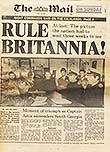 |
midmarket tabloid | Associated Newspapers Ltd | 1,248,194 (2.375m) |
| The Sunday Times | quality broadsheet | News International Newspapers Ltd | 789,557 (1.401m) |
| Sunday Mirror | popular tabloid | Trinity Mirror plc | 603,911 (1.534m) |
| The Sunday Telegraph | quality broadsheet | Telegraph Group Ltd | 356,149 (686,779) |
| Sunday Express | popular tabloid | Express Newspapers | 334,232 (1.007m) |
| Daily Star Sunday | popular tabloid | Express Newspapers | 249,308 (419,262) |
| Sunday People | popular tabloid | Trinity Mirror plc | 232,386 (1.007m) |
| The Observer | quality broadsheet | Guardian Newspapers Ltd (Scott Trust) | 179,215 (444,509) |
| News of the World (closed 2011) | popular tabloid | News International Newspapers Ltd | closed (3.650m) |
| The Business (closed 2008) | quality broadsheet/ magazine | Press Holdings | closed (204,005) |
| Independent on Sunday (online only 2016) | quality broadsheet | Independent Print Ltd | closed (208,563) |
| Sunday Sport | popular tabloid | Sport Newspapers Ltd | n/a (151,892) |
| Source: ABC (abc.org.uk) | |||
Newspaper groups and their titles
| Newspaper groups | Titles owned | Daily market share in 2017 (2005) |
|---|---|---|
| News International (Rupert Murdoch) | Sun, Times, Sunday Times, Sun on Sunday (News of the World) | 34% (34%) |
| Daily Mail and General Trust | Mail, Mail on Sunday | 24% (21%) |
| Northern & Shell (Richard Desmond); owned by Reach since 2018 | Express, Express on Sunday, Star | 14% (16%) |
| Trinity Mirror plc (bought Northern & Shell to become Reach plc in 2018) | Mirror, Sunday Mirror, Sunday People, Daily Record | 11% (15%) |
| Telegraph Group (Barclay brothers) | Daily Telegraph, Sunday Telegraph, (The Business) | 8% (8%) |
| Guardian Media Group (Scott Trust) | Guardian, Observer | 3% (6%) |
| Nikkei (bought from Pearson) | Financial Times | 1% (1%) |
| Back to top | ||
Associated Newspapers (Daily Mail)Owns the Daily Mail, The Mail on Sunday, the i daily (bought from JPI Media in November 2019), London freesheets Metro and London Lite, Ireland on Sunday and the free classified advertising weekly Loot (since October 2001). In March 2021, DMGT bought New Scientist, the weekly science and technology magazine, in a £70m cash deal. It also runs Harmsworth Quays, an £80 million print plant in Didcot, Oxfordshire, which took its name from DMGT's former print works in Rotherhithe, south London, which is now a shopping centre. The company was established in 1905 and is a subsidiary of the Daily Mail and General Trust plc. In February 1999, the trust became the ninth media group to hold a place in the London stock market's list of top 100. Sold control of Evening Standard to Russian billionaire Alexander Lebedev in January 2009 during freesheet war with News International. |
|
| Daily Mail | Founded in 1896 as a popular half-penny broadsheet with the new class of literate working woman in mind by Irish-born Alfred Harmsworth (later Viscount Northcliffe). He had made his first fortune with Answers magazine founded in 1888. The coining of the word 'tabloid' has been credited to him. Reached a million sales in 1900. Middle-market, right-leaning. Saturday edition includes Weekend, a features and TV listings magazine. Tabloid format dates to 1971 when Associated merged the broadsheet Mail with the Daily Sketch under new editor David English. Popular with women. Continued growing in 1980s under the editorship of (Sir David) English. His successor Paul Dacre saw it overtake the Express and the Mirror. In 2014, the Mail newspapers and website overtook The Sun as the UK's most-read newspaper brand. Website is popular outside UK with content focused on celebrities. |
i |
Morning daily for commuters. Launched in 2010 as a sister paper to The Independent. Bought by DGMT in 2019 from JPI Media, having been previously controlled by Evening Standard owner Evgeny Lebedev. |
| London Lite (closed) | Free evening tabloid paper for London launched on 30 August 2006 to protect Associated's Evening Standard and Metro titles against News International's launch, The London Paper. Shared Thisislondon website with the Standard. About 400,000 copies a day were being given away in 2009. Closed in November 2009 after sale of 75% of Evening Standard and its move to a free revenue model. |
Sister to Daily Mail since 1982 (May 2), and the first new Sunday newpaper since the appearance 21 years before of The Sunday Telegraph. Launched with Bernard Shrimsley as editor but David English refused to allow the daily's contributors to write for it. In June, English was knighted; he ousted Shrimsley and brought in his writers in July an event known on the paper as 'The Knight of the Long Knives'. Within a year, the circulation had doubled to nudge 1.5m, partly thanks to the addition of a colour supplement for women, You, in October; Night & Day, for features and arts; and Financial Mail on Sunday. In 2006, a short-lived attempt was made to sell You in newsagents. The Night & Day supplement was relaunched in 2007 at a cost of £8m to attract more male readers an unusual move given that both the daily and Sunday papers have traditionally focused on women. |
|
| Metro | Free morning colour tabloid launched with 40 pages in March 1999 in London, adopting a popular Continental model. It was designed to be read in 20 minutes. Reports put the initial run at 100,000 with dispensers at 72 stations (forecast to rise to 300,000 from 2000). By the end of 2006, versions were available in 12 British cities. |
7Days |
7Days is a free, English language daily published Sunday to Friday in Dubai and Abu Dhabi. DMGT owns 60% of Catchpole Communications, which produces the title. Some 75,000 copies are distributed. |
| Northcliffe Newspapers Group Ltd | Sold its regional newspaper business, to Local World, a large regional newspaper publisher, in 2012. Northcliffe was a top five regional group with 20 daily titles, 27 paid-for weeklies, 62 freesheets and 24 regional web portals with names like Thisissouthwales.co.uk. Also had Hungarian newspaper interests. |
| A&N Media | Develops and runs websites for Associated Newspapers, Northcliffe Media and A&N International Media, such as: This is London; This is Money (February 1999); Femail; Teletext Holidays; and UK Plus search engine. In 2006, bought Primelocation.com, and in 2011 merged online property businesses with Zoopla, keeping a 55% interest in the merged entity. In August 2006, A&N bought website SimplySwitch, a price-comparison website for energy, phone, mobile, broadband and credit cards for £22 million. However, in 2008, DMGT shut it down because it failed to attract enough traffic. It was bought by price-comparison website Moneyexpert.com. Other websites have failed or were sold: This is Travel; UK Plus search engine; Zoom e-commerce portal with Arcadia (Innovations, Hawkshead catalogues); Charlotte Street for women; Big Blue Dog for recruitment, Soccernet (sold to Walt Disney). Closed Teletext TV operations in 2009 and sold 51% share in Teletext Holidays in 2012. |
City AM
City AM is a free business paper distributed to commuters at locations and offices across London and the home counties, on Monday to Thursday. It dropped Friday in 2023 because of the low number of post-pandemic commuters. The paper claimed a daily readership of 275,000 from an ABC certified distribution figure of 128,152 for the first half of 2013; the figure was 67,000 in 2023.City AM launched in September 2005 with 24 full-colour pages and the initial 60,000 copies were printed by Cambridge Newspapers. Its working title was London Business Daily. The paper's strapline was: 'The world of business and the players behind it.'
Former Sunday Express business editor David Parsley was the first editor working from offices near London Bridge station. It aimed to 'bring a touch of the culture of showbiz and celebrity' to covering the 'people who make London's financial districts tick'. Columnists included: Richard Northedge on the City; Ray Snoddy on media; Sam Torrence on golf; and Vicki Butler-Henderson on motoring. It was described as the 'parish newspaper for the City of London and Canary Wharf'.
It was frequently compared with the Financial Times, whose editor, Andrew Gowers, described it in an Independent interview as 'a well-produced product with a good eye for a front-page story.' 'If you want a quick overview of some key stories and you're not near a screen then you can get it from City AM. But if you want added value in terms of stories other people don't have, analysis and authoritative comment then the FT is still the place to go.' ('Pink 'Un goes BlackBerry' by Ian Burrell, 26 September, p4.)
The company, also called City AM, was headed by Lawson Muncaster, who had worked as head of of global advertising sales at Swedish freesheet group Metro International. He was joined by another executive from the company, Jens Torpe. It gained initial funding of £10m. In November 2005, the company applied to register the trade mark City PM, but said it had no plans to launch an evening edition. By the end of thee year it had launcheed a property supplement and talked of editions in Bristol, Edinburgh, Manchester and Leeds.
By the middle of 2006, City AM was trying 'to distance itself from an FT-style readership' with more middle-managers and not necessarily working in a financial business, according to Media Week. It quoted Jeremy Slattery, head of advertising at City AM: 'We believe the business person is also a consumer and we have created a platform to deliver both messages. Basically, the front half is about making money and the back half is about spending it.' ('Financial press try to reinvent to survive' by Sheelagh Doyle, 25 July, p20.) In the summer, it ceased publication for 11 days on the grounds that the City was on holiday.
Circulation grew despite more free sheets launched in London four in 2007. It carried lighter sections such as River Rat and ran a bonus supplement to coincide with City payouts. Its ad sales strategy was questioned in some quarters when it carried non-conventional, triangular ad spaces for Samsung and then a wraparound advertisement for the Times proclaiming: Sharper business writing. The Times. TimesOnline. No 1 for Business.' It also ran fund manager Lyxor Asset Management as sole advertiser in a review of the year edition before Christmas.
In February 2008, Allister Heath left Andrew Neil's Business magazine the day before it closed to take over as editor from David Parsley, who had resigned in August. Heath retained a position as associate editor of the Spectator, a sister title to the Business, also owned by Telegraph publisher Press Holdings.
City AM announced its first profit in the six months to March 2008, raising expectations of an eventual sale. By July, the four free London papers had circulation figures of City AM, 95,000; London Lite, 400,000; the London Paper, 500,000 and London Metro just under 750,000. City AM revived the idea of regional editions, in Manchester and Edinburgh.
In autumn 2012, City AM announced plans to launch, Bespoke, a monthly luxury lifestyle magazine to to pull in upmarket advertising, but also said profits had slumped 95% slump to £20,000 in 2011. Even though two free papers, London Lite (Nov 2009) and the London Paper (sept 2009), had closed, competition had increased in the free sector with the Standard turning free, growth in free weekly magazines, and Time Out going free:
- Evening Standard, 600,000 copies since October 2009
- Metro, 780,000 (March 1999);
- Shortlist, 529,000
- Stylist, 431,000 (Oct 2009)
- Time Out, 300,000;
- Sport, 300,000;
- City AM, 130,000.
ESI Media (Independent, Standard)ESI Media is owned by the Russian oligarch and former KGB agent Alexander Lebedev and his son Evgeny. It controls the London Evening Standard, The Independent (online only) and London Live, the local TV station. The Independent is branded as 'a 24/7 news brand for courageous, heart-felt and independent journalism in the UK and around the world'. An offshoot, the Indy100 is 'a pioneering news and comment platform, which combines quality journalism with user curation to deliver a seriously addictive website'. The Independent has international editions in Spanish, Arabic, Turkish, Persian and Urdu.In February 2016, the company sold off its 'cheapsheet' 40p daily i to regional group Johnston Press and closed the print Independent, making most of the staff redundant and going online only. The company was formed in December 2008 by Alexander Lebedev, a former KGB agent turned banker, who owns a minority share in the Moscow paper Novaya Gazeta with Mikhail Gorbachev, former Soviet president. Lebedev took over the Evening Standard from Associated on 21 January 2009 after months courting its owner Lord Rothermere. He paid £1 for a 75.1% stake at a time when the paper could have been losing as much as £20 million a year. It was the first time DMGT had sold a paper. Questions were asked about the security implications of a former spy, who had been based in London for several years, controlling a British paper (there is a long history of journalists such as James Bond author and Sunday Times writer Ian Fleming feeding intelligence to security services). Lebedev told the Guardian: ‘As far as I'm concerned this [buying the Standard] has nothing to do with making money. There are lots of other ways. This is a good way to waste money’ (‘Welcome, comrade proprietor’, 15 January 2009, p1). The FT reported that just one director – 28-year-old Evgeny, Lebedev’s son, boyfriend of actress Joely Richardson and owner of Sake No Hana restaurant, was listed as a director for Evening Press Ltd. The company was registered in December 2008 with a share capital of £40 million ‘quite a lot for a shell company’ (‘Lebedev junior's Evening Press’, 20 Jan 2009, p18). In its first year of trading, Evening Press lost £28.3m. When The Independent was launched in 1986, it was controlled by a consortium of backers and so was 'independent' of any proprietor. However, poor sales as a result of lack of investment and cutting staff saw it fall into the hands of the Mirror Group and later the Irish newspaper group controlled by Tony O'Reilly. It was the first modern broadsheet to go tabloid, in 2003. In 2010, the Lebedevs bought the Independent and its sister Sunday. In 2016, both became digital-only. In March 2010, London Evening Standard owners Alexander and Evgeny Lebedev paid a nominal £1 for the loss-making Independent and Independent on Sunday (in fact, Independent News & Media paid the Lebedevs $9.25 million to take over the titles). |
|
| The Independent | Announced it would be an online-only paper from March 2016. Launched by former Daily Telegraph journalist
Andreas Whittam-Smith on October 7 1986 after the Times was seen
to drop its politically-independent line to support Margaret
Thatcher and lose its position as Britain's paper of record.
Known as the 'Indie'. Only quality daily launch in the UK
in the 20th century, made possible by the advent
of desktop publishing. Boosted sales in September 2003 through
adopting 'compact' format, initially alongside broadsheet.
By spring 2004, dropped broadsheet version. Move soon followed by The
Times. Launched MediaWeekly supplement in 2004,
challenging Guardian on Mondays.
Original offices were in London's City Road overlooking Bunhill Fields cemetery (burial place of many famous 17th and 18th century writers), hence the title of Bunhill's Notes in Sunday business pages. The 'Weasel' column in the Saturday magazine comes from the nursery rhyme: 'Up and down the City Road,A pub called the Eagle still stands on City Road and 'popping the weasel' means pawning an iron, a popular practice with poor tailors in the area. |
Sister paper to the Independent from January 28, 1990, to 2016. Nick-named 'Sindy'. Had 250,000 sales |
|
| London Evening Standard
|
Became a free daily after being bought by Lebedev from DMGT. Had been London's sole paid-for evening paper since 1980 when formed as a result
of a merger between the Standard and Evening
News. Standard title dates back to 1827. An erosion in quality led Robert Maxwell to launch London Daily News in 1987. Associated responded
by re-launching the Evening News at half the cover
price and squeezed Maxwell out a year later. The Evening
News was then closed. Another competitor, free paper Tonight,
closed within a year of its launch in 1994.
Rupert Murdoch-controlled News International with deeper pockets was reported as planning to launch a free evening in 1999 and The London Paper finally appeared in August 2006. However, Associated had got in first with Metro. Using the same tactics as against Maxwell, DMGT launched London Lite to protect the Standard and Metro. However, the battle took a toll on the Standard's sales and DMGT sold control to Russian businessman Alexander Lebedev. He took a 75.1% stake in 2009. The Standard was relaunched in May under Geordie Greig, former editor of society magazine Tatler, with a brief to focus on upbeat news. Redesigns have seen it adopt the look of Bauer's fashion weekly Grazia with the use of flourescent yellow panels. It expanded its title to become the London Evening Standard. It publishes three editions a day, Monday to Friday, printing at 10am, 3pm and 5pm. On four days it comes with a supplement: London Jobs (Mondays); Homes & Property (Wednesday); Metro Life, a listings guide (Thursdays); and glossy ES Magazine, with celebrity features and arts (Fridays). Carries a media page on Wednesdays. |
i (the essential daily briefing from the Independent) |
Sold to Johnston Press in February 2016. The 20p i newspaper was launched in October 2000 by the Independent for readers who wanted a concise, better quality daily than the free papers but did not want to pay the price. In May 2011, a 30p Saturday edition was launched. By 2011, the i was selling 221,715 copies a day. It was run by Stefano Hatfield, formerly at News International. In the 23 January 2011 issue, Hatfield introduced a new Monday cartoonist, Ben Jennings, who had won the 2011 political cartoon of the year award for a Gadaffi cartoon in the Guardian in August, though still at university. Hatfield also added a daily Codeword to the puzzle page, saying 'This is something readers have asked for since i launched particularly many of you transferring to us from a rival paper that contains one.' (The Daily Mail carried such a puzzle on its centre spread coffee break page.) |
Guardian Media Group
Run by the Scott Trust to prevent papers falling into the hands of interfering proprietors (named after pioneering editor CP Scott). Group has sold off regional newspapers and magazine division. Now only owns two newspapers Guardian and Observer, having sold regional papers amid restructuring in 2007-10. The money was to be invested in digital expansion and radio.Katharine Viner was made editor of the Guardian in 2015, the 12th person in the role and the first woman to run the newspaper in its 194-year history. Viner had been the paper's deputy and editor of Guardian US and took over from Alan Rusbridger, who was 20 years in the job. In an indicative ballot, she won ‘overwhelming support’of Guardian and Observer staff, backed by 53% of those who voted. Rusbridger took over leadership of Scott Trust from Liz Forgan in 2016. There was controversy in 2017 when it emerged that GMG chief executive David Pemsel was paid £706,000 in 2016.
In late 2024, there was a bid for The Observer from the ‘slow news’ website Tortoise Media. Journalists voted for a 48-hour strike against the deal. Tortoise was founded by James Harding, a former editor of the Times and later head of the BBC newsroom.See Guardian's Newsroom archive for history of the paper.
| The Guardian |
Liberal, quality daily. Free website. Nickname: the 'Grauniad'
because of its reputation in the 1990s for literals (which even appeared
in a Netscape browser issued by the paper.) Founded as the Manchester Guardian on 5 May 1821 by John Edward Taylor, a cotton merchant, who had witnessed the Peterloo massacre. At first it was weekly and doubled this frequency in 1836 when stamp duty was reduced. It went daily on July 2 1855 when stamp duty was abolished – the first daily newspaper outside London. The cover price halved to 1d two years later. The paper was vocal in demands to break the telegraph companies’ monopoly of news distribution and in 1868 provincial newspaper owners set up the Press Association. In the same year, the paper set up a London office. It also bought the Manchester Evening News (MEN), which moved into the Manchester Guardian’s Cross Street office opposite the Royal Exchange the next year. The Manchester Guardian’s sales dropped 20% to 40,000 at the turn of the century because of its opposition to the government’s colonial policies in Sudan and the Boer War. Scott played a role in the Balfour declaration of 1917, which laid the foundation for the establishment of Israel, and Irish home rule. The non-profit Scott Trust, which still owns the Guardian, was established in 1936. News replaced advertising on the front page in 1955. The following year, the paper denounced the Suez operation; circulation rose 6% to 183,000.
The paper dropped Manchester from its title in 1959 and printed its first copies in London in 1961. It moved from Fleet Street to share offices and the printing plant of the Sunday Times in Thomson House, Gray’s Inn Road, though editorial control remained in Manchester until 1964. Talks the following year about a merger with The Times came to nothing. The Manchester Evening News marked its centenary in 1968 in a short film, Here is the News. The same year, the group takes a stake in Anglia Television. In 1970, the two papers moved to Deansgate from the Cross Street offices, which were sold for the Crown Square shopping centre. Another MEN documentary, . The Voice of a Region, shows the purpose-built premises. In 1976, the Guardian moved from Thomson House to 119 Farringdon Rd in London. The1988 redesign of the broadsheet by David Hillman was regarded as revolutionary with its introduction of white space (‘art holes’ to its critics). The paper is published in two sections and a European edition is launched. Some journalists and section editors did not like it because there were fewer words on a page; this was exacerbated when the daily G2 supplements adopted a tabloid size in 1992. Words were seen as being downgraded in relation to photographs, illustrations and blank paper. Computerised typesetting was introduced and a new printing plant was built in the London Docklands (the plant was demolished after it was damaged by an IRA bomb in 1996). Printing at Deansgate comes to an end when the group takes a holding in Trafford Park Printers with the Daily Telegraph. In 1991, the group becomes a partner in the breakfast TV franchise GMTV (stake sold in 2000). It also expands its radio interests, though these are sold to Emap after just two years. Two years later, the group bought The Observer, the world’s oldest Sunday newspaper, from Lonrho. The name is changed to Guardian Media Group. November 1995 sees the paper’s technology supplement OnLine ‘surface on the web’ as Go2 (the web address was http://go2.guardian.co.uk). Various other websites are launched and these are given a common branding as ‘Unlimited’ in 1999. Two years later, the URL changes again, from guardianunlimited.co.uk to guardian.co.uk. Plaque celebrating 200 years since its founding unveiled on site of former Cross Street building by mayor Andy Burnham in 2021. Switched from broadsheet to Berliner format (tall tabloid; 315 by 470mm) with colour throughout on 12 September 2005, a change that cost £80m for the MAN Roland ColorMan presses in London and Manchester and printworks. Accompanying redesign of mould-breaking David Hillman look from 1988 led by Mark Porter; liked in the design world but expensive and a questionable commercial decision. New typeface by Christian Schwartz, Guardian Egyptian. However, the Berliner strategy was judged a failure in 2017, when it was reported that the paper planned to go tabloid after all and cut 250 staff, including 100 journalists. The tabloid Times has performed better in circulation terms than The Guardian. Interview with Porter at Design Museum. Guardian reports and pictures of the changes. On 15 January 2012 Porter tweaked the design as part of a cost-cutting exercise. 'Unlimited' special interest websites began in late 1998. Bookselling deal announced with Bertelsmann Online in February 1999, but BOL later closed. Unlimited sites have since been put back under the main Guardian branding. Among the names the websites have come under are:
In 1997, appointed a readers' editor and column of corrections and clarifications. By 2005, 10,000 letters a year were being received and 1,500 entries in the column printed. The principle being that 'a newspaper such as the Guardian, which by definition calls on others to be accountable for what they do, should be accountable for its own journalistic activities'. Widely-praised redesign by David Hillman of Pentagram in early 1988 introduced 'white space' (known as 'art holes' by cynics) to British daily papers with Garamond, Miller and Helvetica typefaces. April 1999 saw a redesign led by Simon Esterson (who had done work on the Observer and was appointed one of only 200 Royal Designers for Industry by the RSA in 2001), which seemed to adopt a more Observer-like look.Very successful classified advertising strategy of introducing themed supplements (Monday, media; Tuesday, education; Wednesday, society; Thursday, technology; Friday, arts review). Various magazine supplements launched in late 1990s. The Guardian's London offices were in Farringdon Road, but it moved to King's Place in 2008. |
| The Observer | The world's oldest Sunday paper: founded in 1791 by W.S. Bourne. Switch to Berliner format as part of a relaunch on 8 January 2006. A Liberal, quality broadsheet. Controlled by the Guardian Media Group since 1993. Before then, often criticised for supporting the interests of its owner company Lonhro and chairman Tiny Rowland, particularly in his battles with Harrods owner Mohamed Al Fayed (who relaunched Punch in early 1996). Published free monthly themed supplements as well as its main magazine: Sport, Music, O Fashion, Woman but several closd in 2010-11. The Observer shares the Guardian's offices in King's Cross. In 2009, there were reports that the Guardian was considering turning the paper into a weekly magazine. |
| Regional newspapers (sold 2010) | Sold Manchester Evening News and Surrey Advertiser (Guildford) and rest of portfolio of 32 paid-for and free titles to to Trinity Mirror for £44.8m in February 2010. |
| Other activities | Sold Money
Observer financial magazine to Moneywise in 2008. In March 2007, sold 49.9% stake in Trader
Media Group to private equity group Apax for about £674m. Based around regionalised editions of Auto
Trader magazine (seen as a cash cow for the group). Emap business magazines (since 2008);
41.9% stake in Delicious publisher Seven Publishing; and 29.5% stake in The Word publisher Development Hell.
Has a history of dabbling in magazines. Launched a UK version of Wired in 1995, though this closed after a couple of years. Radio interests. Owns Trafford Park Printers; educational web materials developer Learnthings. |
New European
The New European is published every Thursday in a colour tabloid format. The pro-European paper was launched ‘as a four-week pop-up publication’ by regional newspaper group Argent after the June 2016 EU referendum result. The editorial strategy was ‘an attempt to rebalance the right-wing extremes of much of the UK national press’. It was bought out of Argent by Matt Kelly, who formed The New European Ltd based in London with backing from a group of investors that included Mark Thompson, the former BBC and New York Times chief. The paper had 9,500 subscribers in 2021 and had set out plans to sell 45,000-55,000 across mainland Europe by 2025.Compare with Robert Maxwell's European from 1990 and current affairs weeklies.
News UK (Sun, Times, Sunday Times)Part of the international News Corp group controlled by Rupert Murdoch. Focus of scandal in 2010 over phone hacking at the News of the World, which was closed as a result, and led to the Leveson inquiry into the ethical standards of the press, both papers and magazines. Has big stake in BSkyB satellite television and ITV (used, controversially in 2006 to block a merger between ITV and Virgin), and controls book publisher HarperCollins. Moved most UK interests under one roof in offices next door to the Shard by London Bridge station, joining the Financial Times south of the Thames (though the FT moved back to Bracken House a few years later).Extensive media interests in the US and Australia. Murdoch changed from being an Australian to take up US citizenship so he could control the Fox TV network. Murdoch's family has succeeded in retaining control of News Corp, and in the 1990s concentrated on television assets in the US and UK. In 2004, Murdoch announced that the group would switch its emphasis online, buying Intermix Media, for $580m in 2005 which gave it control of MySpace.com social network. Having arrived in the UK from Australia to beat Robert Maxwell in buying the News of the World in 1968, Murdoch bought the Sun from IPC. He relaunched this in November 1969 with a 'sex and sensation' formula and topless Page 3 girls, which made household names of models such as Samantha Fox. He then bought the Times and Sunday Times and broke the Fleet Street unions by moving to Wapping in 1986. |
|
| The London Paper (closed) | The London Paper was an evening freesheet launched on 4 September 2006
against Associated's Standard.
It was given away at Underground and rail stations. Set up as a low-cost operation under
editor Stefano Hatfield, who had launched the
Metro freesheet in New York and edited advertising
trade weekly Campaign in the UK. He went on to head up the Independent's 20p sister paper, i.
The paper had a free distribution of about 500,000 copies in July 2009. As a result, Associated sold the loss-making Standard. However, the Murdoch paper fell victim to the recession and announced in August 2009 that the final issue of the London Paper was likely to be on Friday 18 September |
| The Sun (became a seven-day paper in February 2012) | Right-leaning popular tabloid. Best-selling of the 'red-top' dailies, having overtaken the Mirror in 1978, with a formula of sensational stories and topless Page 3 girls created by Larry Lamb. However, lost overall status as the most read newspaper to the Daily Mail in 2014. At its jingoistic height in the Thatcher era with controversial headlines such as 'Gotcha' for the sinking of the Argentinian battleship General Belgrano in the Falklands war. Often credited with swinging public opinion against the Labour leader Neil Kinnock, leading to a third term as prime minister for Thatcher. Editor Kelvin Mackenzie (1981 to 1994) was the most successful tabloid editor of his generation, but lost his way by taking on the Queen in a copyright row after breaking an embargo to publish her Christmas speech. Sun readers sided with the Queen in a telephone poll. Mackenzie was out six months later. Launched free internet provision in April 1999 at Currantbun.com. Later renamed Bun.com, then Page3.com. After the closing of the News of the World in 2011, a Sunday edition was launched on 26 February 2012. This retained the NoW's Fabulous magazine, indeed the Sun has rebranded its women's pages as 'Fabulous'. In January 2015, the Sun dropped its Page 3 topless pin-up models, which had run for 44 years and made household names of models ssuch ass Samantha Fox, after facing pressure from anti-sexism campaigners. |
| The Times | Website runs paywall. Nicknamed 'The Thunderer', because, some say, of the
sound of the presses starting up. However, Bernard
Falk in his autobiography He laughed in Fleet Street
(1933) says it was because 'a leading article
from the pen of Captain Sterling opened one morning with
the words, "We thundered forth the other day an article..."'.
Launched on 1 January 1785 by John Walter I as the Daily Universal Register. Renamed on 1 January 1788. Established its reputation for honesty under John Walter II from 1803, who installed steam printing in 1814, and possibly the greatest editor of the century, John Barnes (1817-41). By 1823 it was 'the greatest engine of temporary opinion in the world…' and the paper of record for Britain, then the most powerful country in the world following the defeat of Napoleon, despite the loss of the Americas. US president Abraham Lincoln said it was 'the most powerful thing in the world except, perhaps, the Mississippi river'. Ran classified advertising for births, marriages and deaths on its front page until May 3, 1966 and on the back page until 1982. The Times was closed down due to an industrial dispute from December 1, 1978 until November, 12 1979. On Friday 13, 1981 it became a sister paper to the Sun, as part of Rupert Murdoch's News International. In 1986, Murdoch broke the print unions by moving to 'Fortress' Wapping, though the damage done to the paper's quality and reputation opened the door for the Independent. Led price war from 1993 when it cut the cover price from 45p to 30p (and 10p on Monday). This raised sales at the expense of the Independent, Telegraph and Express. One weapon in this battle was the launch of The Times magazine as a Saturday colour supplement on 13 March 1993. The broadsheet Times newspaper started a compact (tabloid) edition in November 2003. A year later, the Times dropped the broadsheet. |
| News of the World [closed 2011] | Sunday paper to the Sun. Founded in 1843. Bought by Murdoch in 1969; in doing so created intense rivalry with Robert Maxwell. The largest-selling paper in Britain at 4.5 million copies each Sunday (though down from 8.5 million in 1950). Closed as a result of the Milly Dowler phone-hacking scandal in July 2011, though its colour magazine, Fabulous, was transferred to the Saturday Sun and then the Sunday edition launched on 26 February 2012. The scandal led to the Leveson inquiry into the ethical standards of the press, both papers and magazines, at which editors of all the nationals were questioned, as well as those at Now, Hello! and OK! |
| The Sunday Times | (1882) Best-selling of the Sunday, quality broadsheets. Launched colour supplement in 1962. Bought from the Thomson Group with other Times papers in 1981. In recent decades, at its height in the pre-Murdoch days under the editorship (1967-81) of Harry Evans who nurtured investigative journalism under the Insight banner and championed design. See his books: Good Times, Bad Times (3rd ed, 1994, Phoenix, London); and his five-part series on newspaper journalism, Pictures on a Page, Newsman's English, Newspaper Design, Text Typography and Newspaper Headlines. Design article 'News that's fit to print' described the influence of the Sunday Times and Observer in changing the role of the sub-editor and designer on newspapers. Commercially successful in 1980s and 1990s under Andrew Neil, who introduced the concept of the 'supermarket' newspaper with a section aimed at all kinds of readers. Neil is regularly lampooned in Private Eye as 'Brillo Pad' because of his wiry hairstyle. The Sunday Times was embarrassed when it was taken in by fake Hitler Diaries in 1983. |
| Today [closed] | In November 1995, Today was closed by News Corporation. The tabloid was launched by local newspaper group owner Eddy Shah in March 1986 as the UK's first colour national paper. He sold it to Lonrho, the trading group that also owned the Observer, before it was bought by Rupert Murdoch in July 1987. The closure was seen as a blow to the then-opposition Labour party, led by Tony Blair, because it had a left-of-centre political stance. The cost of a price war instigated by the Times, pressure on printing capacity from that paper's rising circulation, a rise in newsprint costs up by half in a year and the paper's falling circulation (at 573,680) were cited as factors in the closure decision. Mohamed Fayed, owner of Harrods who a year later relaunched Punch, said he wanted to take over the paper but talks failed. |
| Times supplements | In October 2005, News International sold its weekly specialist tabloids Times Educational Supplement (TES), Times Higher Educational Supplement (THS), Nursery World and other newspapers, magazines, websites and exhibitions to Exponent, a private equity group, for almost £235m. These had been seen as cash cows. The group retained the Times Literary Supplement (TLS), which began as a supplement to The Times in 1902 and became a separate publication in 1914. All the supplements have moved away from a newspaper format to a magazine structure. Website Times Money launched but closed. |
| News International Magazines | Set up in 2005 with a brief to capitalise on the growing weeklies market. NI already had two monthly spin-offs from the Sunday Times: Travel (a contract title by River since 1993 that closed in 2020) and Inside Out (closed in early 2007). Women's weekly Love It! launched in February 2006. Reported to be researching weekly news magazine. Took licence for Sky magazine the UK's biggest circulation title for BSkyB's 8m subscribers from John Brown in December 2006 (Murdoch has always been fond of keeping money within the group). |
Northern & Shell (now Reach)
Newspaper and magazine group taken over in February 2018 by Trinity Mirror to form Reach. This followed the sale of Channel 5 in 2014 and the group is now a property developer and runs lotteries.Top-shelf magazines and OK! publisher Richard Desmond bought Express newspapers from Lord Hollick's United MAI for £125m in November 2000. Hollick reformed United as a business magazine and business group, United Business Media. Desmond's interest in music he plays the drums had started with the launch International Musician in 1974, but it was producing the UK edition of US adult magazine Penthouse that made his first fortune. Bought Channel 5 in 2011 to exploit programmes such as Big Brother.United MAI had been formed by the merger in 1996 of Lord Stevens's newspaper-based Express group with Lord Hollick's TV and finance-based MAI group (Anglia, HTV and Meridian franchises as well as production companies). Owned NOP and United Information Group; PR Newswire and Newsdesk International, which distribute press releases online; big shareholder with BT and News International in LineOne Internet provider; Telegraph Colour Library. Sold off consumer magazines (Punch, Auto Express, etc) to concentrate on its Miller Freeman business titles (renamed after US subsidiary; formerly known as Morgan-Grampian). Sold Westminster regional newspapers in 1998 for £450 million (became Regional Independent Media).
| The Express | Founded in 1900 by C. Arthur Pearson who had worked on George Newnes’ Tit-Bits before going on to establish Pearson’s Weekly (1890) and Pearson's Magazine (1896). Middle-market, right-leaning tabloid. Owned by Lord Beaverbrook from 1916 to 1964 when it was sold to Fleet Holdings. United newspaper group acquired the Express papers from Fleet. Under United’s ownership the Express moved from the Fleet Street 'Black Lubianka' to Ludgate House, south of the river on Blackfriars Road. Steady decline since the 1960s with many short-term editors, lack of investment and then cost-cutting and focus on celebrities and cheap, populist journalism under Desmond. The art deco Fleet Street office was known in the 1950s as the Black Glasshouse but later christened the Black Lubyanka by Private Eye. The newsroom was used in The Day the Earth Caught Fire (1961) with the recently retired editor, Arthur Christiansen, playing fictional editor Jeff Jefferson |
| Daily Star | 'Red-top' tabloid launched in 1978. First new national for 75 years, it tried to take on the Sun with colour spreads of topless 'Star Birds'. Sister to the Express. Lack of investment meant failure as mass-market title. Became a niche paper for 'lads' with frivolous, sports-based approach |
| Express on Sunday | Similar editorial strategy and sales as the daily |
| Daily Star Sunday | September 2002 launch |
| Other activities | Lads' portal Megastar spun off from Daily Star but later closed. Clutch of magazines at Northern & Shell, including gossip weekly OK! |
| Back to top
|
|
Pearson plc (sold FT to Nikkei)International education group that sold the Financial Times to the Japanese group Nikkei at end of 2015. A month later, Nikkei said the paper would return to Bracken House on the south side of St Paul's Cathedral in the City of London. The building was built for the paper in the 1950s and named after Brendan Bracken, who had merged the Financial News and the FT to create the modern paper.From being a diverse group of quality companies (including Château Latour, Warwick Castle, Madame Tussauds and oil interests), Pearson concentrated on publishing and TV in the 1990s. In February 1999, it merged Addison-Wesley Longman and Financial Times Management books imprints under one Pearson Education banner. This followed the purchase of educational division of Simon and Schuster from US entertainment group Viacom for $4.6 billion in 1998, making Pearson the largest educational publisher in the world. This included Prentice Hall in the UK. Sold local newspaper group Westminster Press in 1997 and consumer magazines, including Future Publishing in April 1998 (for £142m). Then, it sold the TV division, which included Thames, Grundy (makers of Neighbours) and Pearson TV (Men Behaving Badly) to RTL in mid-1990s, along with rights to games show formats such as Blankety Blank, Blockbuster, Family Fortunes and The Price is Right. US-born chief executive, Marjorie Scardino, was the first female head of a top 100 UK company. She revealed after an RSA lecture (RSA Journal, April 1999) that the question she was most frequently asked was whether the company would relocate to the USA. By 2005, structured as three divisions: Financial Times Group, Penguin books and Pearson Education. 2012 marked her 15th year as head of the group. She was replaced by John Fallon who oversaw a halving of the share pricee, with a particular drop not long before and then again after the sale of the FT. He, in turn, stepped down in early 2020 |
|
| Financial Times | Launched in 1888, the FT markets itself as the world's leading
financial daily. First chairman was Horatio Bottomley, who went on to become an MP and launch John Bull but was jailed for selling fake war bonds in 1922.
About 70% of sales outside the UK. Has daily
editions for UK, Europe, US and Asia printed at about 25
sites. Printed on pink paper since 1893. Lex column once advised readers not to support the FT's
owners Pearson in its plan to buy British Aluminium, after which the column did not cover Pearson until it was sold to Nikkei.
Website has pioneered a paid-for model with limited free access, which it calls a 'metered access model'. Appointed first woman editor, Roula Khalaf, in January 2020. History of the FT.
One of the first daily newspapers to exploit the potential of the Saturday paper. FT Weekend includes the monthly How To Spend It, which is a tabloid-sized glossy, and weekly FT Magazine. |
| Business publishing | Has conference division. Magazine publishing division has 14 titles, including Investors
Chronicle and The Banker. In September 2005,
How to be Better Off, a quarterly magazine, with
BBC Worldwide. FT Business profile |
| Other sites | The Economist was half owned by Pearson, but the company sold it to the other shareholders at the time of the FT sale; Chinese.FT.com; sold interest in FT Deutschland to Gruner and Jahr in 2007, shortly after selling stake in French business paper Les Echos. FT Deutschland closed in November 2013. |
| Back to top |
|
Telegraph Media GroupUS-based investment group RedBird and Abu Dhabi fund IMI together bought the right to own the Telegraph and the Spectator magazine for £600m in 2023 after the Barclay family lost control of the titles. However, they were forced to sell the titles on after MPs raised concerns about the group being partly funded by Abu Dhabi. RedBird-IMI sold the Spectator to hedge fund boss Paul Marshall for £100m, while the Telegraph titles became the subject of a bidding war that narrowed down to between a new RedBird consortium and New York Sun owner Dovid Efune. That looked set to come to a conclusion in 2025 with a price tag of about £550m. However, that also fell apart because of regulatory uncertainty and hostile views among Telegraph staff. A £500m deal was then agreed with DMGT, the owner of the Daily Mail. However, in early 2026, German media group Axel Springer swooped in with a bid of £575m, which was given approval by the UK government in April 2026. That looks to have brought an end to three years of battling over the sale.Sir David and Sir Frederick Barclay's Press Holdings Ltd bought the Telegraph group in 2004 from Hollinger International after main shareholder Conrad Black became embroiled in financial scandal (and was jailed in the US). The Barclay brothers were property developed who moved into the media world by buying the European in November 1991 after the death of disgraced tycoon Robert Maxwell. The weekly had gone through several formats, from broadsheet newspaper to tabloid newsprint magazine before being closed in 1998. Then The Business (was Sunday Business) in September 1997 and The Scotsman. Former Sunday Times editor Andrew Neil has been editor-in-chief since 1996, and publisher since 1999. Press Holdings sold the Scotsman papers to Johnston Press in 2005 for £160m. It backed down from buying the Glasgow-based Herald newspapers in 2003 after protests from Scottish establishment. In 2006, relaunched the weekly Sunday newspaper Business as a magazine, but this was closed in 2008 (in favour of launching a business magazine off the back of The Spectator). Lord Black and Hollinger had gained control of the Telegraph in 1986, after the previous owners, the Berry family, faced financial problems. However, Black himself faced difficulties from the end of 2003. These included lawsuits by angry shareholders in Hollinger International; inquiries by the US financial watchdog, the Securities and Exchange Commission; and an investigation by an independent committee at Hollinger International itself. |
|
| The Scotsman | Edinburgh-based daily sold to Johnston Press in 2005 |
| Scotland on Sunday | Sunday sister to Scotsman sold to Johnston Press in 2005 |
| The Business (folded into The Spectator) | Launched in April 1996 by Tom Rubython as The Sunday Business. Went into receivership a year later. Bought by Barclay brothers and relaunched in February 1998. In July 2006, announced intention to relaunch title in October as a weekly business magazine coming out on Thursdays. Running of the title to be combined with The Spectator and arts and antiques magazine Apollo. However, closed in early 2008 (in favour of launching a business magazine off the back of The Spectator). |
| The European | Weekly colour broadsheet launched by infamous Robert Maxwell. Bought by Barclays in 1992 after his death. In July 1997 plans were set out to transform The European into an upmarket magazine but it closed in 1998. European case study |
| The Daily Telegraph | Britain's best-selling quality paper with strong news and sports coverage. Right-wing (nickname: the Torygraph). Failed to hold on to a million sales a
day, after long price-cutting campaign by the Times.
Had overtaken the Times soon after its launch
in 1855 (originally as The Daily Telegraph and Courier)
when the price was cut to a penny. Launched Weekend Telegraph colour supplement on Fridays in 1964 and renamed it as The Daily Telegraph Magazine in 1967. In 1986 the paper came under the control of Canadian-born Conrad Black. The re-introduction
of the word 'The' in the paper's title was the subject
of a front-page news item when Max Hastings took over
as editor. The first of the UK broadsheets to mount
a significant web presence (although the Guardian's
Online section on a Thursday had long used electronic
bulletin boards and e-mail). Also has special
interest 'satellite' sites. In 2006, an internal reorganisation
saw many redundancies and the launch of a digital newsroom. Has digital subscription service |
| Sunday Telegraph | Sister to the Daily Telegraph founded in 1961, the first new national Sunday for 40 years. It aimed to fill the gap between the 'two serious and voluminous newspapers whose emphasis is on magazine features' [Sunday Times and Observer] and those papers that 'tend towards triviality and sensationalism' [News of the World, Sunday Express, etc]. A front-page box stated: 'While deliberately restricting its paging to a manageable size, it will also give a larger proportion of its space than other Sundays to succinct reporting and explanation of news, home and foreign.' It launched its own colour supplement, Telegraph Sunday magazine in 1976. |
| The Spectator | Right-wing political weekly carrying quality writing. Established 1828. Claims to be the oldest continuously-published magazine in the English language. Bought by hedge fund boss Paul Marshall for £100m in 2023. Taken into Telegraph group by Conrad Black in 1988. Glorious history of publishing famous writers since the Victorian era. String of recent famous editors includes: Nigel Lawson, the former Conservative chancellor under Thatcher (1966-70); Alexander Chancellor (1979-84); Charles Moore (1984-90); Dominic Lawson (1990-95), son of Nigel; Frank Johnson (1995-2000); Boris Johnson, who would later become a short-lived prime minister (2000-06); Matthew d'Ancona (2007-09); Fraser Nelson (2009–24); former Tory minister Michael Gove (2024–). See: To Convey Intelligence: The Spectator 1928-98 by Simon Courtauld, 1999. |
| Other Telegraph sites | Several attempts to create brands based around newspaper readership faltered and these have been rebranded as part of the paper: Juiced student magazine; Internet for Schools; The Planet for travel; Connected brand based on Tuesday's science and technology pages no longer used; Global Network for ex-pats based on weekly overseas version of the paper; Telegraph Appointments Plus. Books Online passed over to Splashweb. Other launches sold or closed down: UK Max search engine; luxury goods portal Best of British sold to Whittards in June 2000. Handbag.com sold to National Magazine Company (now Hearst Magazines UK). Had been launched with Boots in October 1999 targeting women with a free ISP. Boots claimed 90% of all UK women went through its doors each week and the Electronic Telegraph reached a million online. |
| Other | Apollo arts and antiques monthly magazine founded in 1925 |
| Back to top |
|
Reach (was Trinity Mirror)In February 2018, Trinity Mirror announced the takeover of the Express, Star and OK! titles from Northern & Shell in a deal costing it £170m. It also said it would change its name to Reach. Already claimed to be the biggest UK newspaper publisher with 250 titles. Formed from takeover of Mirror Group by Trinity regional group in 1999. Set out £150m strategy in 2000 to create offshoots of ic24 internet service provider. Earlier, Mirror Group had been bought from Reed International by the infamous Robert Maxwell in 1986. Sold after his death in 1991 to a group led by David Montgomery with, for four months, Lord Hollick as chairman. Strategy fell apart in early 1999 with acrimonious departure of Montgomery (nick-named Rommel: 'because Monty was on our side') in dispute with chairman Victor Blank. Sold 18% share in Scottish Media Group to Granada as part of restructuring. Then bought by Trinity. National newspapers divided into MGN Ltd and Scottish Daily Record & Sunday Mail Ltd. Some 240 regional newspapers run as 10 operating businesses account for almost a quarter of the regional market. |
|
| The Mirror | Popular, Labour Party-supporting 'red-top' tabloid founded in 1903 by Irish-born Alfred Harmsworth (later Viscount Northcliffe). He had made his first fortune with Answers magazine founded in 1888. Largest-selling paper in 1960s until overtaken by Rupert Murdoch's Sun. In the 1980s, a circulation battle with the Sun saw Robert Maxwell introduce £1 million bingo prize and put himself on the cover promoting it. First mass market daily to use colour regularly (1988), though smaller circulation Today had colour and the Mirror's Scottish sister, the Daily Record earlier. |
| New Day | In February 2016, Trinity announced the launch of a national 'cheapsheet' weekday paper: ' The New Day, which will run to 40 pages every day, will be printed on high quality news print and be visually striking. It will be available for free from over 40,000 retailers on its first day, Monday 29 February, and then will trial at 25p for two weeks before retailing at 50p after that.' It would compete with the 40p i, bought that same month by regional group Johnston Press. |
| Sunday Mirror | Sister to the Mirror. Founded as Sunday Pictorial in 1915; changed name in 1963 |
| The Sunday People | Sunday tabloid since 1974, part of the Mirror Group. Established in 1881 as The People. Bridget Rowe, former editor of both Woman's Own and the TV Times was the editor in 1992, having moved across from the Sunday Mirror. Prominent magazine columnist Hannen Swaffer was editor in 1924. |
| Racing Post and Sporting Life |
The twice-weekly Sporting Life was founded in 1859 and became a daily. It disappeared from the newsstands when it was merged with Racing
Post in May 1998 by Mirror Group. Racing Post was sold for £170m to Irish private equity group FL Partners in October 2007. The Post had
been launched by Sheikh Mohamed in 1986, but sold to
the Mirror in December 1997. Plans to re-launch the Life
as a daily sporting paper, along a Continental model, dropped
in March 1999. However, the name carried on as a website and
betting venture as part of BSkyB. The private equity firm Exponent acquired the company in 2016 and four years later Racing Post Group was rebranded as Spotlight Sports Group.
Sporting Life was commonly known as the Queen Mother's favourite newspaper. Jamie Reid in a commentary on its closure (Guardian, 5/3/99, p23) said: 'Whenever a British film in the Forties and Fifties wanted to signify that some George Cole or Terry Thomas character was a touch wide, they would show them smoking a Players Navy Cut and reading the Sporting Life'. According to research quoted by Roy Greenslade (Guardian Media, 8/3/99, p4), a daily sporting paper might achieve of 220,000 copies a day (plus or minus 40,000). This was based on a cover price of 40p with a weekday pagination of 48 and 80 pages on a Sunday. However, the marketing bill would have been £10 million in the first year and Mirror group was in poor financial shape following the departure of chief executive David Montgomery a month before and a bidding war that had broken out for the group between regional newspaper groups Trinity and Regional Independent Media. In 2026, the Sporting Life website was controlled by Hestview Ltd, a UK-based company that was part of the Sky Betting & Gaming group. |
| Daily Record | The largest-selling Scottish paper, claiming a readership by half of the Scottish population. First national paper to carry extensive colour (1971). |
| Sunday Mail | (Scotland) sister to the Daily Record. |
| Regional newspapers | Mirror Group Regional Newspapers, a top five regional company with 44 papers, including Midland Independent Newspapers acquired in 1997 (Birmingham Post and Evening Mail) and Northern Ireland's number two title, the News Letter. |
| Other | Launched web portal in March 1999 as ic24 (later bought by PlusNet) with offshoots in 2000: icShowbiz; icChoice; icSport and icTravel. Also 14 regional sites. Sports sites Soccerbase.com (now part of Racing Post) and Cricketbase. Sells its archive of pictures and cartoons such as Andy Capp at Mirrorpix.com. In 1998, launched internet paper dot.com, distributed free with Wharf, a local paper for Canary Wharf, where the papers are based in London's Docklands. Live TV cable channel sold off in 1999 and some papers in Northern Ireland. In July 2006, sold trade magazines and exhibition business Inside Communications to private equity-backed Ocean Media for £41.5m. |
| Back to top | |