



Women's weeklies shaken up
by Tony Quinn
The traditional women's weekly magazines – based around the home and family – were shaken up in 1987 by the arrival of German publishers who brought in a mix of real life stories, fashion, beauty, food, home, travel and competitions to the UK – personified by the runaway weekly bestseller, Take a Break. Then, Hello! arrived from Spain, bringing with it the germ of the celebrity magazines. With OK!, Richard Desmond achieved the success with a mainstream magazine that gave him – as a publisher of pornographic magazines – the credibility to buy the Express newspaper group.Celebrity magazines dominated the headlines in the early 2000s, but IPC saw the weekly real-life sector as the way forward in 2005 with Pick Me Up , while Emap bought in Grazia from Italy as a weekly Vogue . The weekly trend has been partly driven by supermarkets, which want a faster turnover. Monthlies have their biggest sale in the first 10 days and can then sit on the shelves, but they bring a quality feel to a shop and are much more expensive
News was the flavour of the year for 2006, with First and In the Know hitting the shelves. Then, in January 2007, IPC tried to cross celebrity with high street fashion and launched Look. However, by the spring of 2008, both In the Know and First had folded, Emap had been broken up and a period of consolidation set in.
- Buffeted by change
- Celebrity shake-up
- Turning up the Heat
- Victims and price cuts
- Women's weeklies go Nuts
- Yet more titles
- So who's winning?
- Table: Women's weeklies: details and sales
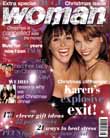 Woman was launched in the 1930s as one of the first full-colour gravure magazines and is still a big seller 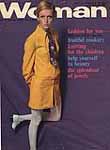 But Woman's sales peaked in the late 1950s, and have fallen gradually since – this Twiggy cover is from the 1960s |
Buffeted by changeIPC – the 'Ministry of Magazines' – had long seemed in control of the woman's weekly sector with Woman, Woman's Own and Woman's Weekly. Between them, these titles sold 3m copies a week in the 1980s (though this had halved since the mid-1960s). IPC's strategy was to undercut any newcomers on price and advertising rates, so forcing them out. However, two German groups with deep pockets – Bauer and Gruner + Jahr (part of Bertelsmann) – decided to take IPC on in 1985 with Bella and Best respectively. The result was a bloody nose for IPC, from which its traditional weeklies have never recovered. Instead, the market evolved, with Chat proving a big success for IPC. Today, in a classic example of niche marketing, IPC's Connect division sees the women's weeklies as split into four types:
In 2004, IPC claimed to hold the top slot in the first three sectors with Now, Woman and Woman's Weekly and Chat second in the real-life stakes, though all were a long way behind Take a Break . That picture looked less rosy in mid-2006 with Emap's celebrity due Heat and Closer taking celebrity honours. IPC still holds on to the classic and mature sectors, but both are fast declining. Meanwhile, Emap is trying to build two new weekly categories:
|
 Spain's Hola! arrived in 1988
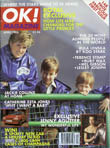 OK! was monthly at first – this is a sample issue 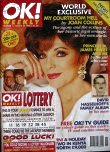 A Joan Collins cover, with 'weekly' in the masthead |
Celebrity shake-upMay 17 1988 was another watershed for women's weeklies with the launch of Hello! , a version of Spain's royalty-driven women's weekly, Hola! The magazine was a success in its own right, despite being pilloried for its fawning attitude to its interviewees, but in spawning Celebrity magazines (and perhaps their controlling attitudes towards the press), its effect was to be far more wide-reaching.Another publisher, Northern & Shell, had built up a publishing empire with the franchise for Penthouse and more downmarket men's titles such as Asian Babes . Attempts to 'go straight' failed until the launch of OK! in April 1993. This was at first a large format monthly competing with weekly Hello! A 16-page preview was distributed with the Sunday Express (one of papers N&S was to take over in 2000). The year 1993 also saw the short-lived spoof Guess Who! arrive. OK! was taken weekly by ex-Woman's Own, TV Times and BBC/Redwood editor Richard Barber in March 1996. A couple of month's later, Gruner + Jahr entered the fray again with Here!, to be followed in October by Now from IPC. Australian actor Mel Gibson on the cover must have done the trick, because just seven months later Gruner + Jahr sold Here! to IPC, who folded it into Now. |
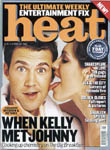 Heat started as an entertainment weekly but found greater sales when it switched to celebrities 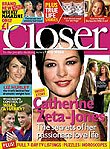 Emap described Closer as its best launch |
Turning up the HeatEmap was the next entrant with the entertainment weekly Heat in 1999. This did not fare well at first but a switch of emphasis to a celebrity magazine saw sales soar. Northern & Shell jumped on the bandwagon with the cut-price New! (at 70p). It also added Hot Stars as a freebie with OK! . Emap, though, had bigger plans, which came to fruition with Closer . This had a first sales figures around the 340,000-mark (2002). Emap ruled it the company's most successful launch yet. And it has carried on selling, breaking the 500,000 barrier in the second half of 2004 – a rise of 30% on a year earlier.The two companies continued to joust, with Emap giving away Ooh! Scandal! as a spoiler for the launch of N&S's Star in 2003 and threatening legal action against any Heat copycats. Other titles, particularly IPC's traditional weeklies, lost ground. The UK's largest publisher was treading creative water, having been brought out by managers in 1997 from Reed with money from venture capitalist Cinven. Its lack of innovation and the closure of titles in the next five years has been attributed to a focus on generating profits, in preparation for a sale to Time Warner in 2001. |
 Your Life magazine failed to make a mark in the crowded weekly magazine market
 |
Victims and price cutsAs the popular celebrity sector grew, there were victims. Two IPC titles, Woman's Journal and Woman's Realm closed in 2001 and 2002. Their replacement, Your Life , also failed.At Northern & Shell, Richard Desmond's strategy of buying access to top celebrities worked for OK! in overtaking Hello! . The latter stuck to its royalty-based guns but even Desmond's wallet was stretched and OK! increasingly began to have to make do with B and C-list names. This put it into competition with lower-priced competition, including Desmond's own launches. Both OK! and Hello! lost 100,000 sales. By May 2004, celebrity magazines were in a price war. IPC's Now cut its cover price by 20p to £1 in a bid to maintain its position as the top-selling celebrity weekly, because Emap's Heat had cut the sales gap to 30,000 copies. As well as Now, Closer, New! and Star were all using price as a selling tool. |
 Reveal was an October 2004 launch from National Magazines  Pick Me Up brought a real-life focus to IPC 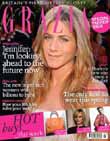 The free sample issue of Grazia used Jennifer Aniston for its cover |
Women's weeklies go NutsThe success of men's weeklies Nuts and Zoo from IPC and Emap galvanised publishers to look to weeklies for growth. National Magazines launched Reveal in a £16m campaign to add to weekly Best and monthly Prima (both taken over from Gruner & Jahr when the German publisher quit the UK in 2000). Also, it formed a partnership in 2004 to produce weekly magazines with Australian Consolidated Press in the UK, ACP-NatMags. Then, Emap announced it was to import the Italian fashion weekly Grazia . So it was no surprise that IPC was working on a weekly, code named 'Project Spitfire'. Its move back to more traditional values with an emphasis on real-life stories was more of a surprise. However, Chat 's sales have continued to rise, despite the celebrity frenzy, while the likes of Woman 's have fallen. June Smith-Sheppard, Chat's editor, was launch editor for the new title. It may be that the UK's most experienced publisher saw the celebrity sector going off the boil and Pick Me Up as the way forward.Things didn't stopped there. The first 10 weeks of 2005 saw a launch frenzy. In February, Grazia, 'Britain's first weekly glossy', arrived from Emap. It was a confident first issue. The focus was on fashion, led by celebrity covers – Jennifer Aniston, Kate Moss, Nicole Kidman for the first three issues. A massive £16m launch saw 650,000 taster copies being given away a week before the launch. A fortnight later, OK! and Daily Express publisher Northern & Shell launched a cheap woman-focused TV listings title, Take 5 , though it did not last long. Within a week, German group Hubert Burda Media jumped in with Full House, a package of true life stories, celebrity, prizes and puzzles. The switch to weeklies was as a response to the growing power of supermarkets. Monthlies achieve the bulk of their sales in the first two weeks and can languish on shelves for a fortnight. Increased frequency gives the supermarkets – which resist giving their precious shelf space to new magazines without dropping existing ones – a higher turnover. Supermarkets want high circulation and high frequency – turning magazines into 'fast moving consumer goods' in the marketing jargon – like tins of beans. So 2005 was shaping up as the year of the weekly, particularly for women. |
 Real People from ACP-NatMags 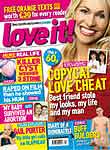 Love It! marked a return to UK magazines for Rupert Murdoch  You: only lasted 6 months on the shelves 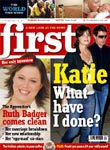 First – another attempt by Emap to create a new type of weekly 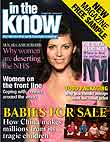 In the Know from Bauer folded in May 2007  Look had a debut sales figure of 318,907 |
Yet more titlesThe first few weeks of 2006 saw two launches. In January, the joint venture company formed by National Magazines and Australia's ACP threw Real People (Project Star) into the crowded real-lives sector with a £6m marketing budget. Also, newspaper magnate Rupert Murdoch had seen what was going on in magazines and decided to get a piece of the action. A News International magazines division was set up and February 2006 saw the arrival of Love It! with a celebrity/real life mix and reports of more weeklies on the way. Another newspaper, The Mail on Sunday also had its eyes on women's weeklies and put out its You supplement as a sold magazine, but this only lasted until August.In April 2006, Burda, a German company that publishes real-life weekly Full House, bought Essential publishing. Among its titles, was women's fortnightly Real (which it had bought from Bauer, another German group, in 2004). Come May, First, a weekly news magazine for women aged 34+, hit the newsstands. The success of Grazia emboldened Emap into trying to establish another new sector. Falling sales among its classic weeklies saw IPC pump money into relaunching Woman in the same month. It was relaunched to create a 'modern and exciting style, with a positive, warm and confident tone'. Summer saw Emap launch a dieting and fitness website, Closerdiets, based on Closer. IPC extended the reach of celebrity gossip weekly Now with Nowmagazine.co.uk and Reality TV Now, the sixth in a series of specials, which includes Teen Now, Diet Now and Style Now. As the year went on the real-life titles became freakish and gruesome in their coverlines – 'My boob exploded', 'Boiled in the bath' and 'Wooed by the wife thief's wiggle'.As the season drew to a close, German publisher H Bauer came along with its 'topical and relevant' women's weekly In the Know. Comparisons were made with First, but the company stressed the originality of the celebrity-free package with its £10m backing. However, In the Know closed in May 2007, with the title never getting over a lacklustre start – and demonstrating the need for big launch budgets. Also, First struggled. Emap decided to give the title a make-over with a new editor for a September 2007 relaunch and try to achieve the sort of effect it had when it relaunched Heat. News International was setting itself up to launch a women's weekly in the New Year under former Hello! editor Maria Trkulja – ‘Project Danny/Dannii’. |
So who's winning?So who's winning in the women's weekly magazines sales wars? Well, first off, the women's weekly sector is. In the second half of 2004, the titles sold 8,812,271 copies on average each month; in the first six months of 2006, that figure had grown by 10% to 9,852,702. The overall number of titles increased from 19 to 26. Some of that growth has come from monthly readers switching to a weekly read.As for individual publishers, H Bauer is the main loser, its titles dropping 15% of their sales. This probably reflects their age, so there must have been a lot riding on In the Know. That the title failed – the third failure in a row – was a big problem for the German group, as sales of Take a Break ebb away. However, the break-up of Emap gave the German publisher its chance and in 2008, it became the UK's biggest magazine publisher by buying up Emap's consumer magazines – though its first move was to close New Woman and First. Also, Bauer had managed to improve sales of its TV listings weekly TV Choice to close on IPC's What's on TV – the UK's top-selling magazine. IPC has been working very hard to stay still but Pick Me Up has a least covered the losses among its once-commanding classic titles and Look appears a winner as a high-street version of Grazia. The fact that Emap had expanded its roster of women's weeklies was a boon for Bauer, with Emap taking the second and third spots ahead of IPC's titles. Grazia also commands a high cover price and potentially premium page rates for its advertising. However, Bauer would not give First any more time to demonstrate that it could work. Its roster of women's weeklies now runs to:
DC Thompson is paying for a lack of innovation, while Hello! has picked up after a weak period – but maintained an upmarket readership – and The Lady continues its genteel decline. The new boy on the block, News International with Love It!, has turned in a good result and demonstrates the marketing power of free advertising in its national newspapers for the title. |
| Total sales for the main publishers (2004 and 2006) | |||
| Sales Jul-Dec 04 |
Sales Jan-Jul 06 |
Change (%) |
|
| IPC | 2,680,644 | 2,715,892 | 1 |
| Bauer | 2,252,608 | 1,903,805 | -15 |
| Northern & Shell | 1,137,122 | 1,275,262 | 12 |
| Emap | 1,056,565 | 1,345,312 | 27 |
| ACP-NatMags | 650,967 | 1,022,533 | 57 |
| DC Thompson | 616,961 | 554,502 | -10 |
| News International | 0 | 405,441 | n/a |
| Hello! | 382,391 | 403,666 | 6 |
| The Lady | 35,013 | 34,302 | -2 |
| Women's weeklies: ranked by sales (mid 2006) | ||||
| Title | Publisher | Sector | Launch date | ABC sales (Jan-Jul 2006*) |
| Take a Break | H Bauer | Real Life | 1990 | 1,082,051 |
| Closer | Emap Entertainment | Celebrity | 28 Sep 2002 | 590,211 |
| Grazia | Emap | Fashion/Celebrity | 21 Feb 2005 | 220,125 |
| Heat | Emap Entertainment | Celebrity | 6 Feb 1999 | 579,883 |
| Chat | IPC Media | Real Life | 1985 | 554,375 |
| Look | IPC Media | Fashion/Celebrity | 30 Jan 2007 | 318,907 |
| Now | IPC Media | Celebrity | 24 Oct 1996 | 539,902 |
| OK! | Northern & Shell plc | Celebrity (weekly since 2 Jun 1996) |
Apr 1993 | 547,714 |
| That's Life | H Bauer | Real Life/Classic | June 1995 | 490,220 |
| New! | Northern & Shell plc | Celebrity | 3 Mar 2002 | 458,751 |
| Pick Me Up | IPC Media | Real Life | 27 Jan 2005 | 445,098 |
| Woman | IPC Media | Classic | 1937 | 417,362 |
| Love It! | News International Magazines | Real Life | 17 February 2006 | 405,441 |
| Hello! | Hello! Ltd | Celebrity | 1988 | 403,666 |
| Woman's Weekly | IPC Media | Classic | 1911 | 391,426 |
| Woman's Own | IPC Media | Classic | 1932 | 367,729 |
| Best | ACP-NatMag | Practical | 1987 (Gruner + Jahr) | 362,183 |
| People's Friend | DC Thompson & Co | Mature | 1896 | 355,522 |
| Reveal | ACP-NatMag | Celebrity/Real Life | October 2004 | 342,245 |
| Bella | H Bauer | Practical/Real Life | 1987 | 331,534 |
| Real People | ACP NatMags | Real Life | 19 January 2006 | 318,105 |
| Star | Northern & Shell plc | Celebrity | 8 Nov 2003 | 268,797 |
| My Weekly | DC Thompson & Co | Classic | 9 April 1910 | 198,980 |
| Full House | Burda | True life/celebrity/puzzles | 8 March 2005 | 191,987 |
| Grazia | Emap | Fashion/celebrity | 21 February 2005 | 175,218 |
| The Lady | The Lady | Mature | 1885 | 34,302 |
| First | Emap | News/celebrity | May 2006 | new |
| In the Know | H Bauer | News | 29 August 2006 | new |
| Hot Stars | free with OK! (N&S) | Celebrity | 7 Feb 2002 | n/a |
| Ooh! Scandal! | free with Heat | Celebrity | 1 Mar 2003 | n/a |
| Take 5 | Northern & Shell plc | Celebrity/listings | 11 March 2005 | closed |
| *Source: Audit Bureau of Circulations (ABC, https://www.abc.org.uk) | ||||
| Women's weekly magazines: back to top | ||||
Women's weekly magazine profiles
Women's magazine sales 1938-59
Buying and selling women's magazine and celebrity magazines
Pick Me Up first issue – real life was the way forward for IPC