

Glossary of magazine terms and jargon
This is a glossary of terms and jargon used in magazines and magazine publishing. It has been quoted by the PPA in the Mag Scene careers guide. NB: terminology varies between industries, titles and internationallyUse Ctrl-F to find specific words on this page.
| MB | megabyte. Approx a million bytes | |
| Mb | megabit. Approx a million bits | |
| macro | a computer routine that carries out a sequence of tasks | |
| magazine | periodical that is published frequently. In 1755, Samuel Johnson's Dictionary defined the word in its publishing sense: 'Of late this word has signified a miscellaneous pamphlet, from a periodical miscellany named the Gentleman's Magazine, by Edward Cave' | |
| Magazine Publishing Association (MPA) | trade body that represents US consumer magazine publishers. Established in 1919 | |
| magazination | the process whereby newspaper have becomee to look more and more like magazines since the 1990s | |
| makeready | preparing the printing press for a production run | |
| managing editor | journalist who carries out managerial tasks on behalf of the editor. Usually includes production and budgetary duties, while still having writing and editing responsibilities | |
| manga | Japanese comic books. Sectors include: bijinesu manga - business manga; bunkashi - literary; manga magazine - manga-zasshi; ecchi/hentai - for adults (abbreviated to h-manga). Manga sometimes called komikku (because it sounds like the English comic), hence rediizu komikku, comics for women | |
| marketing | carrying out advertising, publicity, public relations and events campaigns to promote a magazine to readers, advertisers or the distribution trade | |
| MARS | Magazines Add Real Sales. PPA-run 2005 research study aiming to show advertisers when buyers actually read magazines | |
| mascot |
magazine and newspaper mascots include:
|
|
| masthead | 1 since the late 1980s, the name of a publication usually printed
at the top of the cover or wrapper, often as a logo and
often accompanied by issue number and date
2 the box that gives details of the publisher, staff and contact information. Different publishers put this information in different places: on the contents page or on the leader page or on one of the pages near the back of a magazine. It is often accompanied by the magazine's logo 3 also used for the titlepiece or logo - the name of the magazine in its chosen font on the front cover |
|
| Matchprint | colour proofing system. Trademark of 3M | |
| media pack | promotional material to help sell advertising space | |
| metamarism | phenomenon of a colour looking different under different lighting conditions | |
| media | methods of communication used for information and entertainment, such as print, television, radio and the internet | |
| media pack | information used by a publisher to attract advertisers. Usually includes: data on circulation; advertising rates; editorial policy; copy of the magazine | |
| media quadmap | chart that plots the profile of a magazine against two criteria, such as the age and socio-economic group of its readers | |
| meg | see megazine | |
| mega | standard international unit prefix meaning a million; generally, something very large | |
| megazine | special issue of a title devoted to a single subject. The Judge Dredd Megazine was a spin-off from 2000 AD in October 1990 (Dredd lived in Mega City 1). Also, 'Life ... began publishing special newsstand 'megazine' issues on topics such as 9/11 and the Holy Land in 2001. These issues, which were printed on thicker paper, were more like softcover books than magazines.' [http://en.wikipedia.org/wiki/Life_(magazine)] | |
| merchandising | selling of products other than magazines by a publisher, for example, T-shirts | |
| m/f | more (copy) follows | |
| Mobizine | Platform for cut-down versions of magazines that can be downloaded to mobile phone. Trademark by Refresh Mobile | |
| modem | MOdulator DEModulator. Device for converting digital data into analogue pulses to be sent down telephone lines and converting them back again | |
| mook | Publications that are more thorough than magazines and more timely than books. Derived from 'magazine' and 'book' (Japan) | |
| mottoes | magazines and newspapers use mottoes to sum up their editorial philosophies:
|
|
| MPA | Magazine Publishers Association (US) | |
| m/s | abbreviation of manuscript: the raw copy provided by writers | |
| Miller, Beatrix | American editor of Queen magazine from 1959 into the mid-1960s and then of Vogue for 22 years. Known as 'Miss Miller' to staff and 'Bea' to friends | |
N |
||
| net | used as opposed to gross. A net figure is lower than gross. For example, a net sales figure for a magazine would exclude unsold copies, 'returns'. London Opinion in 1914 stated: 'The Daily Mail says that when they [other publishers] won't publish the net sales it looks fishy' ('Whipped Topics, 6 June). At the time, the Mail was trying to establish more creditable circulation figures and declared that its figures were audited by an accountant and that they were net sales, rather than the number distributed (unsold copies would take weeks to be returned) | |
| net paid circulation | total paid circulation, either through single copy newsstand sales or subscription in ABC reports. Payment must be not less that half of the cover or subscription price | |
| Neuman, Alfred E. | mascot for Mad in the form of a freckled boy | |
| News of the Screws | nickname for the News of the World | |
| new media | digital media such as CD-Rom, websites, broadcast e-mail and web casting | |
| newsprint | cheapest type of printing paper. Produced from wood pulp. Typically 45 g/sq m | |
| NFRN | National Federation of Retail Newsagents (UK). Rebranded as Federation of Independent Retailers ('The Fed') in 2017. Employers’ association with 15,000 independent shops as members in 2020 | |
| non-heatset printing | uncoated paper absorbs ink, so heat is no needed to dry the pages after printing | |
| non-paid circulation | free copies of a publication sent to individuals who meet certain criteria set by a publisher | |
| NRS | National Readership Survey. Matches newspaper and magazine buying patterns to demographic data. Published yearly (UK). NRS Xtra is a separate survey of about 50 computer titles |
O |
||
| OBC (BC) | outside back cover | |
| OCR | optical character recognition. Technique for scanning printed text into a computer. Text can then be checked – such systems are never totally accurate – edited, and used for other purposes | |
| official organ | a periodical for members of an association or group | |
| offset litho lithography or offset printing | main printing method for UK magazines. Ink from image on litho plate is transferred to a rubber blanket, which then comes into contact with the paper | |
| OJD | Office de Justification de la Diffusion de la Presse Payante. French organisation tracks circulations (www.ojd.com) | |
| open prepress interface (OPI) | computer system that enables allows files to be shared across a network and replaces printing-quality files with lower-resolution versions for production work | |
| opens | the number of times a digital magazine is 'opened'. See 'publication opened criteria' | |
| outsert | preprinted material attached to the exterior of
a magazine or inserted with the magazine into a plastic bag for posting |
|
| overheads | costs of running a business that are not directly related to the business, for example the costs of heating and lighting | |
| overrun | extra copies above the set print run that are charged to the publisher at a 'run-on' rate | |
| ozalid | a proofing system whereby light-sensitive paper takes an image from the black printing film | |
P |
||
| Pagemaker | software from Adobe for typesetting and page layout | |
| pagination | the number of pages in a publication. Simple in theory, but not in practice. Some publishers number the covers, some don't. So the total number of pages in a magazine with 96 as the page opposite the inside back cover may be 96+2 (back covers) or 96+4 (front and back covers). This may be complicated by the use of gatefold covers and bound-in inserts; or special sections (which sometimes have separate numbering). A magazine with a total of 100 pages is common because it is very efficient for printing purposes: 6 x 16-page sections plus cover | |
| paid circulation | copies of magazine that are sold through newsagents or subscriptions | |
| paper sizes | the ISO range of A, B and C sizes is used in Europe. A4 is the most common size of sheet used for office stationery. It measures 210x297mm and is approximately the size of most magazines. In practice, consumer magazines are printed on presses that use reels of paper - imagine a very large toilet roll of paper - called webs. The printed paper is cut, folded and trimmed, so the actual size of a magazine page varies between titles. Short-run magazines are produced on presses that are fed with RA or SRA sheets, each of which is slightly larger to allow for gripping, ink bleeding and trimming. So SRA3 trims down to A3 size. For more details, see Print Workx guide. US titles are still based on the Imperial measurement system of feet and inches. | |
| Pantone | colour specification and matching system developed by US company of the same name | |
| pass-along reader | someone who reads a publication that was purchased by someone else. Typically, there are 3 readers to each magazine sold, though the figure can be much higher | |
| Paternoster Row / Square | area near St Paul's Cathedral in London that was the centre of the publishing industry until it was destroyed by bombers in The Blitz in 1942. Answers to Correspondents, the magazine that founded the Harmsworth magazine and newspaper empire, had its first office at 26 Paternoster Square, premises it had taken over from WB Horner & Son, publisher of Horner’s Penny Stories and Woman's Own and many religious tracts | |
| Portable Document Format. File format used by Adobe's Acrobat | ||
| peckers or woodpeckers | slang for wood engravers in the Victorian era | |
| Pendennis | diary column in The Observer, the Sunday newspaper, from 1959 (written by Anthony Sampson) until 2009. The name comes from a novel by the Punch satirist William Makepeace Thackeray, The History of Pendennis: His fortunes and misfortunes, his friends and his greatest enemy. This was published in 24 monthly parts from November 1848 by Bradbury & Evans following the success of Vanity Fair, which had been published in 20 monthly parts by Punch from January 1847. Thackeray had earlier used the name Arthur Pendennis in his Punch column, 'The Snobs of England', which ran for a year from 28 February 1846 | |
| perfect binding | printed sections are laid on top of one another, glued at one edge and held together by a cover to produce a square spine. More expensive than saddle-stitching, but has a perceived higher quality | |
| periodical | a publication with a fixed interval between issues | |
| Periodical Publishers Association (PPA) | trade body representing magazine publishers in the UK. Renamed Professional Publishers Association in about 2010 | |
| Periodicals Training Council (PTC) | Former UK careers and training body run by the Periodical Publishers Association (PPA) | |
| PIB | Publishers Information Bureau (US). Tracks advertising carried by consumer magazines | |
| pica | unit of typographical measurement; six picas equal one inch | |
| picture-snatcher | a person once employed by UK newspapers with the disreputable job of finding pictures of people in news stories, for example, by stealing them from a home or even a police record | |
| pink sheet | publisher's statement (printed on pink paper) of circulation over a six-month period that is certified by the ABC (US) | |
| PiP | pricing in proportion. Royal Mail package charging system based on size and format rather than weight since 21 August 2006 | |
| Pira | Printing Industries Research Association. Carries out technical research on behalf of printing, packaging and publishing companies. Based in Leatherhead, UK | |
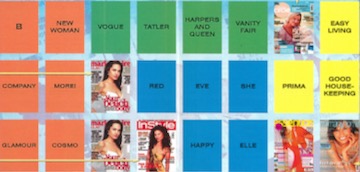
| planogram | diagram showing where magazines shoould be displayed on newsagents' shelves. The Marketforce planogram below is from Retail Newsagent in 2005. It shows where 5 IPC titles should be placed among competing titles based on similar readerships | |
 |
||
| plate | flexible metal or plastic sheet that carries the page image in the printing process | |
| PMT | photo-mechanical transfer. Technology of paper-based typesetting using light-sensitive paper to carry images | |
| point of sale material | promotional posters, shelf-talkers, etc, supplied to shops to attract consumers to buy a magazine | |
| portal | website that aims to act as a general or subject-specific entry point to the web. Magforum is a magazine industry portal | |
| positive | repro film that reproduces the original image's light and shade (as opposed to negative) | |
| PostScript | computer language for describing images as mathematical curves. Trademark of Adobe | |
| PPA | see Professional Publishers Association (was Periodical Publishers Association) | |
| pre-clipped coupon | advertiser's coupon that is printed separately and inserted into a publication or bound in | |
| preferred position | the page where an advertiser would like his copy to appear (though is not guaranteed) | |
| premium position | page in a magazine for which a higher advertising rate is charged | |
| prensa rosa | 'pink press'. Celebrity magazines in Spain, such as Hola! | |
| presse people | celebrity magazine sector in France | |
| production | processes involved in the manufacture of a magazine, from making of film through to printing and binding | |
| promotion | activities carried out to assist advertising sales department or distributors in meeting sales targets | |
| proof | evidence provided in the form of a copy of a page to demonstrate that typesetting or printing work has been carried out as specified in advance of print run | |
| proofreading | the checking of proofs to ensure writers and designers work has been accurately carried out | |
| PTC | see Periodicals Training Council | |
| 'publication opened' criteria | measure of how many times a digital magazine has been opened being developed with ABCe and software providers such as Ceros. Includes filters to eliminate 'opens' made by the publisher and spy techniques that aim to ensure the figures are accurate | |
| publisher | 1. the person responsible for the profitability of a publication
2. a publishing company |
|
| Publishers Row (US) | nickname for part of Sixth Avenue in New York's Manhattan district where many US publishers, such as Time, News Corp, McGraw-Hill and Simon & Schuster, have offices | |
| publisher's statement | stated sales figure that has not been audited | |
| pull quote | phrase or sentence taken from an article and set in a larger type size to attract the reader's attention |

